



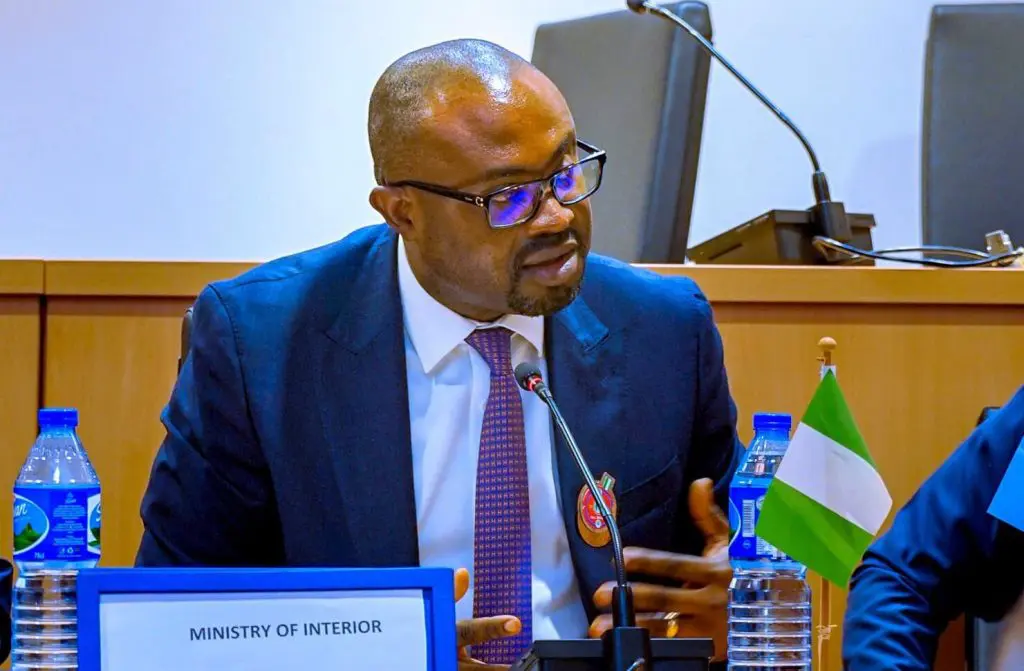

Minister of Interior Olubunmi Tunji-Ojo has challenged former Vice President Atiku Abubakar’s proposal to reopen Nigeria’s land borders if elected president in 2027, insisting that the country’s borders are already open.
Tunji-Ojo made the clarification in a statement on Saturday while reacting to Atiku’s comments on his proposed border policy.

The minister, who oversees the Nigeria Immigration Service, said the government had continued to facilitate legitimate movement and trade across the country’s borders under controlled conditions.
“As the Minister of Interior who supervises the Nigeria Immigration Service, an agency of government in charge of border and migration management, it is expedient to state that Nigerian borders are not closed and so cannot be reopened,” he said.
Tunji-Ojo recalled that the previous administration reopened four major land borders — Seme, Illela, Maigatari and Mfum — on December 16, 2020.
He added that Idiroko and Ikom were subsequently reopened for goods and services on April 20, 2022, while the current administration reopened Kamba and Tsamiya border crossings in Kebbi State in February 2026, linking Nigeria with Niger Republic and Benin Republic.
The minister also rejected Atiku’s suggestion that the borders with Cameroon, Chad, Niger and Benin had remained shut for an extended period because of Nigeria’s 2019 trade policy.
According to Tunji-Ojo, restrictions on crossings along the Cameroon border, particularly Banki and Amchidé, were introduced years earlier because of the Boko Haram insurgency.
“The prolonged closures on the Cameroon border, at Banki and Amchidé, did not arise from the 2019 trade policy at all. They date to 2014, when Boko Haram forced their closure for security reasons,” he said.
He explained that the crossings were reopened in 2019, while Fotokol and Gambaru followed in 2021 after security and stabilisation efforts involving Nigeria, Cameroon, Niger and Chad.
“Folding this separate, security-driven history into one continuous 2019 shutdown misrepresents two distinct issues, trade regulation and counter-insurgency, as a single failure,” Tunji-Ojo said.
The minister acknowledged that some border crossings in the northern part of the country still operate under restrictions, but attributed the situation to persistent security threats.
READ ALSO:
- Asake Submits Four Entries For 2027 Grammy Awards
- Driver Escapes Injury As Train Crushes Car In Lagos
- Truck Runs Over VIO Officer In Ondo
- Court Dismisses El-Rufai’s Suit Seeking To Stop Bank Account Freeze, Asset Seizure
- Kidnappers Collected ₦6m To Release My Son, NYSC Member’s Mother
“Not every northern crossing is fully unrestricted today. Where banditry or residual insurgent activity persists, tighter control is a deliberate security judgement, not neglect,” he said.
He warned that removing restrictions without addressing security concerns could leave traders and communities around the borders vulnerable.
Tunji-Ojo argued that Nigeria’s border policy should balance security with documentation, customs requirements and the facilitation of legitimate trade, rather than relying on either complete closure or unrestricted access.
“Modern border management is not a choice between total closure and unrestricted movement; it requires security, documentation, customs compliance and controlled trade facilitation together,” he said.
He also called on Atiku to provide specific details of his proposed border policy and explain how it would differ from the current system.
“If he has a new border proposal, he should set it out and explain how it differs from the current approach, rather than treating separate trade, security and infrastructure issues as one and the same,” the minister said.
Tunji-Ojo further warned against allowing political rivalry to distort the history of Nigeria’s border management.
“Political competition should not become a competition to rewrite recent history,” he said.
Atiku, who has sought the Nigerian presidency in six election cycles since 1993, has also proposed developing seaports in the South-South and South-East as part of efforts to address what he described as an imbalance in the country’s import and transportation infrastructure.
During his 2023 presidential campaign, Atiku said he had engaged shippers and ship-development companies in Europe over possible support for developing ports in the two regions.
Lagos currently hosts Nigeria’s busiest seaports, while states including Akwa Ibom and Bayelsa also have coastlines along the Atlantic Ocean.