




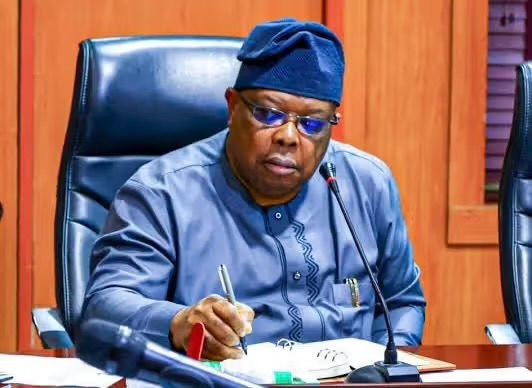

The Federal Government plans to settle the outstanding legacy debt owed to electricity generation companies (GenCos) by 2027, Minister of Power Joseph Tegbe has said.
Tegbe disclosed this on Friday in Lagos while speaking at the Harvard Business School Association of Nigeria (HBSAN) Energy Conference, where he also called for changes to the electricity market structure to prevent the accumulation of further unpaid obligations.

He said the government had successfully paid about N1.23tn through a bond arrangement and intended to complete the remaining payments by next year.
“We have brought in bonds. We’ve paid about N1.23 trillion successfully, we plan to finish paying by next year,” he said.
However, the minister stressed that clearing the accumulated debt alone would not resolve the sector’s financial challenges. He said the government was examining the electricity market’s structure and design to ensure the problem did not recur.
“But again, it’s not just paying the backlog or legacy debt. The plan is how to make sure it doesn’t happen anymore and one of the ways that we’re trying to make sure this happens is to take a second look at the market structure and market design itself.”
Tegbe also questioned some of the tariff assumptions underpinning the Federal Government’s electricity subsidy, arguing that the existing arrangement was not sustainable.
He said Nigerian Bulk Electricity Trading Plc had reached a stage where its continued role in purchasing and selling electricity needed to be reconsidered. According to him, some market participants exploit the structure, which allows the government to cover tariff shortfalls.
“And my plan at the end of the day is to move from that model. That model will not help us. We can’t keep covering tariff shortfalls and think we’ll be able to give power to every Nigerian,” Tegbe said.
He advocated a shift towards bilateral agreements between electricity suppliers and distribution companies, noting that some arrangements were already operating under the model.
“So all we need to do is to move to bilateral agreements, and we already have bilateral agreements working.
“Mainstream Energy Solutions Limited (MESL) supplies IBEDC, Mainstream supplies Ikeja DisCo and they pay because mainstream will supply you what you pay, rather than somebody who will say the government will always give you money.”
READ ALSO:
- My Wife Never Fought Actresses I Dated — Yinka Quadri
- A’Court Dismisses El-Rufai’s Bid To Overturn Bail Denial
- FG Targets 2027 To Clear Outstanding Electricity Debt To GenCos — Tegbe
- Asake Submits Four Entries For 2027 Grammy Awards
- Driver Escapes Injury As Train Crushes Car In Lagos
The minister further identified underutilised power generation capacity as another challenge facing Nigeria’s electricity sector, particularly in the Niger Delta.
He cited Alaoji as an example, saying the facility had the potential to generate about 3,000 megawatts but was producing only around 400 megawatts.
Meanwhile, Chief Executive Officer of the Nigerian Midstream and Downstream Petroleum Regulatory Authority (NMDPRA), Rabiu Umar, stressed the need for investments across the gas and power value chains to remain commercially viable.
Speaking at the same conference, Umar said projects in gas processing, transportation and electricity generation must generate sufficient revenue to enable investors to repay loans and earn profits.
“But at the same time, we also must be careful because if the off taker that is supposed to pay for the service is also overcharged, it the creates a problem,” Umar said.
He maintained that Nigeria’s domestic gas market was not yet mature enough to function as a fully liberalised market, making some degree of regulation and price control necessary.
Umar added that the Petroleum Industry Act provides for a transition towards a free market, where prices would eventually be determined through willing-buyer, willing-seller arrangements.
On September 22, he said Nigeria would end domestic gas price regulation by September 2028 as part of plans to establish a fully operational willing-buyer, willing-seller market.