



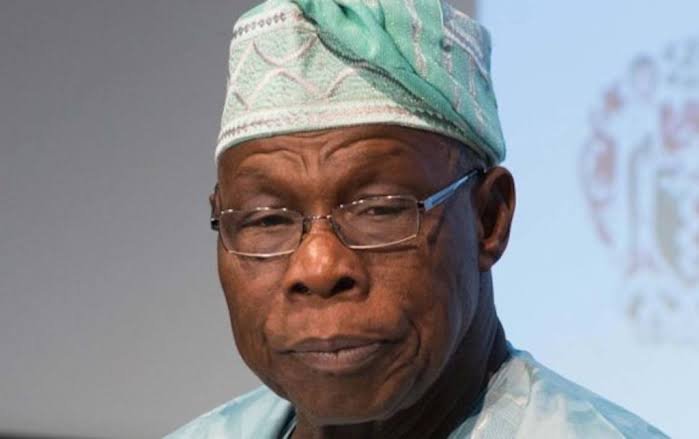

Former President Olusegun Obasanjo has faulted President Bola Tinubu’s defence of his administration’s borrowing policy, describing the claim that borrowing is not leprosy as “absolute nonsense”.
Obasanjo made the remarks on Friday at the Ajibosin Platform, a public forum held in Abeokuta, Ogun State, with the theme, “Leveraging Artificial Intelligence to Solve Grassroots Problems and Accelerate National Development”.

In April, Tinubu had defended the government’s decision to take loans when necessary, arguing that borrowing was not something to be feared as long as the country worked hard to repay its debts.
“If we have to borrow, we borrow. Borrowing is not leprosy; we just have to work hard to be able to pay for it,” the President said.
But Obasanjo disagreed with the position, arguing that the consequences of accumulated debt could extend beyond individuals and affect entire generations.
“And for anybody to say debt is no leprosy is absolute nonsense. Debt is worse than leprosy. Because leprosy destroys only one person. Debt destroys generations,” the former President said.
His comments came days after Tinubu sought the National Assembly’s approval for a supplementary external borrowing plan of $20.52bn and €1.04bn to finance projects and programmes across various sectors.
The request was contained in a letter read by Senate President Godswill Akpabio during plenary on Tuesday.
Tinubu said the proposed loans would support investments in power, transportation, healthcare, education, agriculture, water supply, security, job creation and financial management reforms.
The President later defended his administration’s borrowing from international institutions and banks, saying Nigeria required sustained investment in infrastructure to realise its ambition of becoming a $1tn economy by 2030.
In an essay titled, “From Reforms to Delivery: Our Infrastructure Investment and Growth Strategy”, Tinubu argued that the focus should be on the benefits derived from borrowed funds rather than the amount obtained.
“The real question is not how much we borrow, but what we build, what value we create and what future we leave behind,” he said.
However, Obasanjo questioned the country’s economic progress over the past 47 years, pointing to the sharp fall in the value of the naira against the dollar.
Recounting his experience when he established his farm 47 years ago, the former President said the naira was then exchanged at N1 to $1.85.
“When I started my farm, 47 years ago, naira to the dollar was one naira to $1.85. Forty-seven years ago. What has Nigeria done in 47 years that we now have 1,500 naira to the dollar? What have we done?” he asked.
READ ALSO:
- Hamzat Unveils 100-Point Manifesto Ahead Of 2027 Lagos Governorship Election
- Obasanjo Slams Tinubu Over Borrowing Comment, Says Debt Is Worse Than Leprosy
- FG To Begin Monthly ₦50,000 Cash Transfers To Vulnerable Households
- El Niño: Lagos Lists Precautions Against Heat Exhaustion, Heatstroke
- Thugs Attacks Sowore In Ekiti
He also expressed concerns about the capacity of the country’s political leaders to make decisions capable of improving the lives of Nigerians.
“What do our leaders know? And what do they not know? And from what they know, what can they do for us?” he asked.
Obasanjo further criticised Nigeria’s dependence on foreign financial institutions, particularly the World Bank and the International Monetary Fund, questioning whether their economic recommendations adequately considered the country’s unique circumstances.
He recalled that Nigeria had previously been discouraged from providing subsidies to farmers, despite agricultural support programmes in developed countries.
“World Bank and IMF were not designed for us. They were not built by us. They were built before we became independent. And that’s the people who would determine what we do,” he said.