



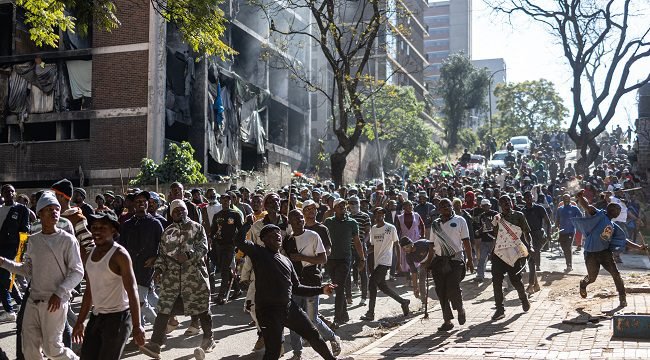

Thousands of demonstrators took to the streets across South Africa on Tuesday, calling for undocumented foreign nationals to leave the country following weeks of anti-immigration protests that have displaced thousands and left at least four people dead.
Security personnel were heavily deployed nationwide as demonstrations reached a peak after campaigns led by citizen groups that had set an unofficial June 30 deadline for undocumented migrants to leave the country.

There were reports of isolated clashes, including incidents of stone-throwing and confrontations near Johannesburg, where law enforcement officers escorted some foreign nationals away from angry crowds.
Authorities confirmed that several arrests were made over looting, while soldiers were deployed overnight in Johannesburg and Durban to maintain order.
In Johannesburg, groups of demonstrators carrying sticks and flags marched through the city centre as many shops remained closed, transport services slowed and workers stayed away.
In Durban, located in the Zulu region, protesters appeared in traditional warrior clothing and carried spears, shields and whips, while some wore leopard skins.
One of the protesters, Brightness Gumbi, 48, said economic hardship had fuelled frustration among locals.
“The illegal foreigners manage to pay it because they sell drugs to our people,” she told AFP. “I hope through these demonstrations our president will hear our cries and enforce stricter laws.”
South Africa, one of Africa’s largest economies, continues to attract migrant workers while dealing with unemployment above 30 per cent, rising crime concerns and pressure on public services.
Groups behind the demonstrations argue that undocumented migrants contribute to job shortages and strain public resources, although analysts have said foreign nationals are being unfairly blamed for broader governance and economic challenges.
READ ALSO:
- Tinubu Accuses Opponents of Creating Hunger, Poverty at Kaduna Rally
- Military Tanks, Personnel Deployed at Abuja City Gate Ahead of Obi-Kwankwaso Mega March
- Zlatan Unveils Traditional Wedding Photos
- Okoya Family Disputes Fatai’s Firstborn Claim, Reveals Benefits Received
- Macron Postpones Nigeria Visit Amid Protests, Unrest in France
Police said at least four people — including two Mozambicans, one Ethiopian and one Malawian — had lost their lives during the recent unrest.
Authorities also confirmed that a foreign national died on Tuesday in Durban after allegedly jumping from the eighth floor of a building out of fear that people were pursuing him.
As concerns escalated, several African countries including Nigeria, Malawi, Ghana, Zimbabwe and Mozambique arranged voluntary evacuation flights and buses for citizens returning home.
Officials said more than 25,000 people had already been processed for departure in recent weeks.
Justice Minister Mmamoloko Kubayi said late Tuesday that nearly 4,300 foreign nationals had been repatriated in recent days, while over 400 others had been deported.
The government of Liberia also announced plans to evacuate 29 of its citizens.
Addressing supporters in Durban, anti-illegal immigration campaign leader Jacinta Ngobese-Zuma said:
“We want mass deportation.
“For the next six months, we want the government to get rid of the people who have not left,” she said, adding that her group would continue weekly protests until local elections scheduled for November.
Meanwhile, hundreds of migrants, mainly from Malawi and Zimbabwe, remained gathered in centres across Cape Town, Johannesburg and other areas waiting for support to return home.
Some migrants said they had lost accommodation or jobs as landlords and employers feared penalties or attacks.
“The people in South Africa, they don’t want us here. I’m scared,” said a 23-year-old Zimbabwean woman in Cape Town, where more than 1,500 people were reportedly awaiting repatriation.
Only a small number of Malawians remained in Durban after thousands had already been transported either home or to processing centres near the Zimbabwe border.
“I thought I could stay on but neighbours warned us last night,” 32-year-old Adam John told AFP. “I felt that it is better to try and get home while I still can.”
Ahead of the June 30 demonstrations, President Cyril Ramaphosa announced stricter government measures aimed at curbing illegal immigration, including stronger border monitoring and increased inspections.
South Africa has experienced deadly anti-foreigner violence before, including unrest in 2008 that resulted in 62 deaths.