



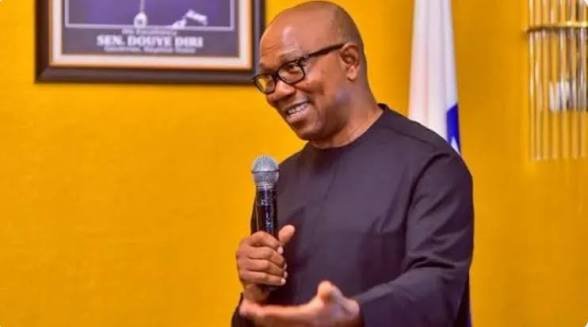

Former Anambra State governor and 2027 presidential candidate of the Nigeria Democratic Congress (NDC), Peter Obi, has pledged to increase Nigeria’s electricity generation and distribution capacity to 10,000 megawatts within four years if elected president.
Obi made the promise on Saturday after emerging as the party’s presidential flagbearer during the NDC national convention held in Abuja, where delegates ratified his candidacy as the party’s sole candidate for the 2027 election.

In his acceptance speech, Obi expressed concern over Nigeria’s electricity situation, describing it as unacceptable that a nation of more than 200 million people generates only about 4,000 megawatts of power.
According to him, Nigeria’s electricity output remains significantly lower than that of countries such as South Africa and Egypt despite having a larger population.
“It is totally unacceptable. Today, Nigeria is a country with the highest number of citizens without access to electricity in the whole world. About 100 million Nigerians don’t have access to electricity,” he said.
“In today’s world, it is unacceptable. A country of over 200 million people only generates and distributes 4,000 (megawatts).
“The biggest economies in Africa— South Africa and Egypt — generate over 40,000 megawatts today.
“So we are not even producing 10% of what these two African nations are producing and distributing. Both of them are less than 50% of our population and they generate 10 times the electricity we generate. These are African countries.
“It is unacceptable. It cannot happen. And I pledge on behalf of our government that in four years, this country will generate and distribute at least 10,000 megawatts from the 4,000 they are doing today.”
READ ALSO:
- Tope Alabi Issues Legal Warning Over Alleged False Publications
- One Dead, Three Injured as Two-Storey Building Collapses in Lagos
- Umahi: Lagos-Calabar Coastal Highway May Stall if Tinubu Loses 2027 Election
- NLC, TUC Give FG Until Tuesday to Address Workers’ Demands
- Actor Francis Duru Passes Away
Obi also questioned the unemployment figures released by the National Bureau of Statistics, which put the country’s unemployment rate at 4.3 percent in the second quarter of 2024.
He argued that the data does not reflect the realities faced by many Nigerians and promised that his administration would address unemployment through support for small businesses and targeted incentives aimed at boosting job creation.
His remarks come months after the Federal Government announced that electricity generation rose from 3,951 megawatts on March 28 to more than 4,300 megawatts by April 10, 2026.