




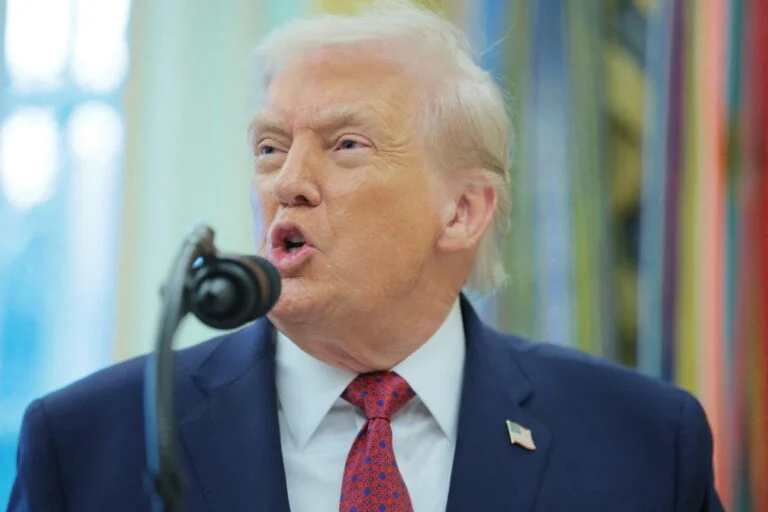

United States President Donald Trump has expressed strong disapproval of a US Supreme Court decision that invalidated his global tariffs on Nigeria and 184 other countries.
The Supreme Court ruled on Thursday that the tariffs, imposed last year, were illegal, Bloomberg reported. Speaking at the White House on Friday, Trump described the verdict as “deeply disappointing.”

Al Jazeera quoted him saying: “The Supreme Court’s ruling on tariffs is deeply disappointing, and I’m ashamed of certain members of the court, absolutely ashamed, for not having the courage to do what’s right for our country.”
On April 2, 2025—referred to by Trump as “Liberation Day”—the administration introduced a baseline 10 per cent tariff on imports from all nations, alongside additional “reciprocal” tariffs of 11 to 50 per cent on countries with significant trade deficits with the US. Under this policy, Nigeria was subjected to a 15 per cent tariff.
The measures, enacted under the International Emergency Economic Powers Act (IEEPA) of the 1970s, targeted what Trump described as unfair trade practices, hitting countries such as China (34%), Cambodia (49%), and Japan (24%). At its peak, tariffs reached 50 per cent on key trading partners like India and Brazil, and up to 145 per cent on China in 2025.
However, the Supreme Court, in a 6–3 decision, ruled that Trump overstepped his authority by using an emergency law to impose such broad tariffs, stating that congressional approval is required for measures of this magnitude. The justices noted that the emergency powers invoked “falls short” of authorizing tariffs of that scale.
READ ALSO:
- Plateau Killings: ‘No Amount Of Money Can Replace Them’ — Tinubu Comforts Jos Victim’s Mother
- “Nigeria Is Yet To See Tinubu’s Best” — Gbenga Daniel
- “I Brought Mercy Aigbe Into Nollywood, Now She Blocks Me” — Olaide Olabanji
- “I Don’t Know My Cancer Stage, I May Have Exaggerated” — Blessing CEO Opens Up (Video)
- Trump Claims Iran War Nearing End As Tensions Escalate
Chief Justice John Roberts, delivering the lead opinion, emphasized the need to maintain the constitutional balance between Congress and the executive on trade matters.
“Allowing the administration to prevail would replace the longstanding executive-legislative collaboration over trade policy with unchecked Presidential policymaking,” Roberts wrote. He further clarified:
“The president asserts the extraordinary power to unilaterally impose tariffs of unlimited amount, duration, and scope. In light of the breadth, history, and constitutional context of that asserted authority, he must identify clear congressional authorization to exercise it. The President must point to clear congressional authorization to justify his extraordinary assertion of the power to impose tariffs. He cannot. When Congress grants the power to impose tariffs, it does so clearly and with careful constraints. It did neither here. We claim no special competence in matters of economics or foreign affairs. We claim only, as we must, the limited role assigned to us by Article III of the Constitution. Fulfilling that role, we hold that IEEPA does not authorize the president to impose tariffs.”
The court clarified that its ruling applies solely to the “Liberation Day” tariffs and does not affect individual tariffs imposed under other statutory powers. It did not provide guidance on whether the $134 billion already collected from over 301,000 importers would be refunded, according to data from United States Customs and Border Protection as of December 14.