



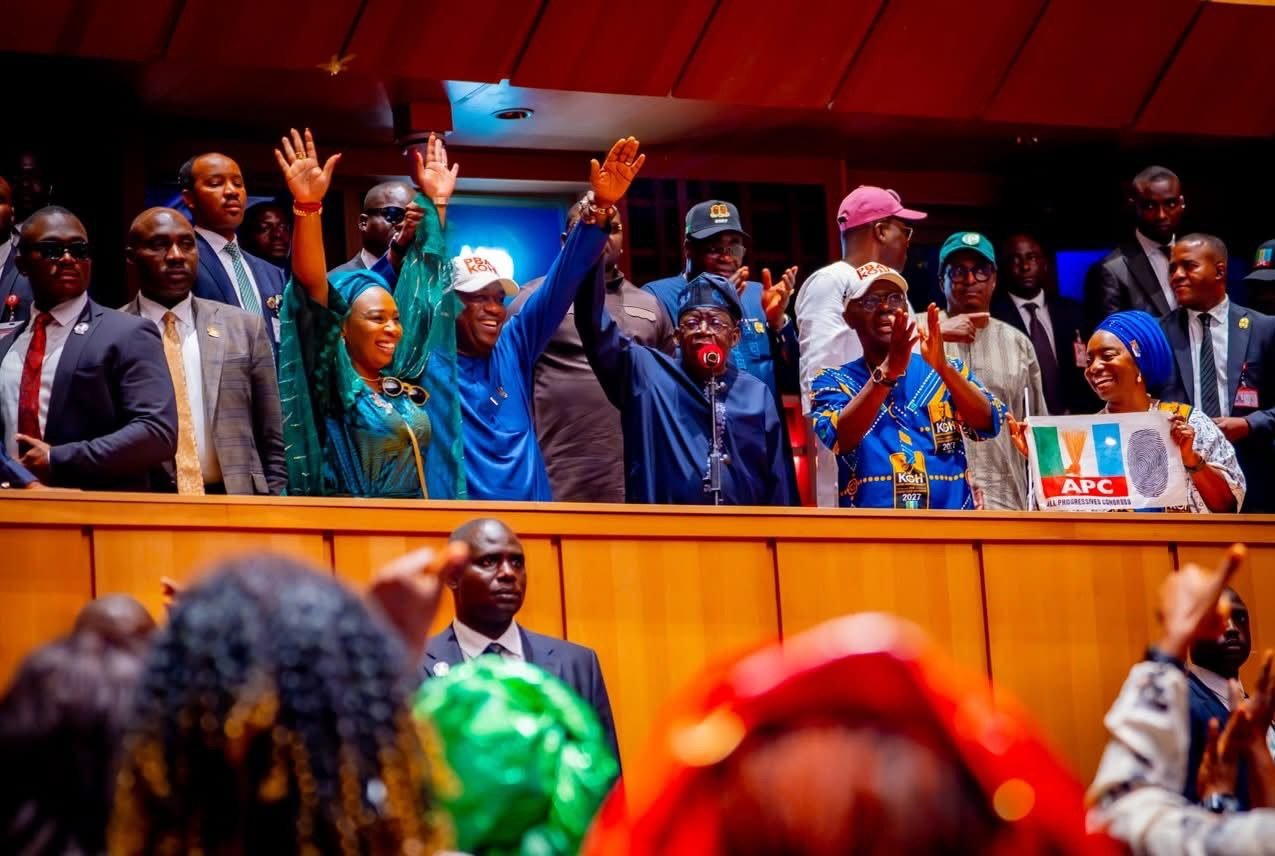

President Bola Tinubu has admitted that he was unhappy with many Igbo residents in Lagos for not supporting him during the 2023 presidential election.
He made the remark on Monday while addressing youths, elders and leaders of Ndigbo at a town hall meeting held at the Wole Soyinka Centre for Culture and Creative Arts, National Theatre, Lagos.

The event was organised by the Ndigbo National Dialogue and Development Initiative.
Tinubu used the occasion to reaffirm his administration’s commitment to inclusive governance, national unity and equal opportunities for all Nigerians.
He called on the Igbo community to remain united, increase its involvement in national politics and collaborate with other ethnic groups towards building a peaceful and prosperous country.
The president also acknowledged the contributions of Igbo people to Nigeria’s economic development, assuring them that no part of the country would be neglected under his Renewed Hope Agenda.
He thanked the participants for making time to attend the meeting despite their business and other commitments.
“To all of you, I am grateful for one thing: that you are here this afternoon. You left your businesses, left money-making to come and listen to the president, and I must say thank you,” Tinubu said.
He stressed that national progress depended on shared responsibility, understanding and cooperation among Nigerians.
Tinubu further encouraged the Igbo community to use dialogue and constructive engagement to address its concerns and promote its interests within the Nigerian federation.
Explaining some of his administration’s policies, the president said efforts were being made to prevent disruptions in tertiary institutions caused by industrial actions and ensure that children from poor backgrounds had access to higher education.
“To eliminate the crisis in the universities and to build good roads and the engineers that will maintain our cars, our children must be in school. Just because they are poor doesn’t mean they must not go to university or develop,” the president said.
He identified the Nigerian Education Loan Fund (NELFUND) as one of the initiatives introduced to support students, adding that his government was also investing in agriculture and businesses.
“We are doing that with NELFUND. The university is stable today because we are doing well. We are putting money into agriculture and trading, and anyone in the trade business can apply to the Bank of Industry and get a loan; anyone in agriculture can take a small farmers’ loan.
“We have to maintain this country for the sake of every one of us. The critical line in our national anthem is what I’m standing here for. I begged for it, and I am ready to serve.
“And I served the first term. The constitution says I can ask for a second term. I want a second term. As you are here today, you make me happy, you make me excited, and I will go home happy and eat (Akpu).”
Tinubu also appealed to Igbo residents in Lagos to obtain their Permanent Voter Cards and support him, the All Progressives Congress (APC) governorship candidate, Obafemi Hamzat, and other party candidates in the forthcoming elections.
“I am here to listen to you. I am here to work with you. Igbos are my brothers and sisters,” he said.
“Some of you did not vote for me in 2023; I vex o. Now, we have settled. Get your PVC, and you will vote for me this time. Come by January 16; you will vote. Agreement is agreement. Tinubu is APC.”
READ ALSO:
- Tinubu To Igbos: ‘I Was Angry You Didn’t Vote For Me In 2023, Support Me In 2027’
- Delta Imposes Curfew In Ughelli North After Deadly NDC Rally Violence
- Four Killed As Gunmen Attack Omo-Agege’s Campaign Team In Delta
- Fidelity Bank replaces an Amazon with a Titan as Amuchie assumes office as MD/CEO
- Nigeria Not Ready To Host World Cup Yet, Says FIFA President Infantino
The Independent National Electoral Commission (INEC) has fixed January 16, 2027, for the presidential and National Assembly elections.
Background
Tinubu contested the 2023 presidential election on the platform of the APC against Peter Obi of the Labour Party and Atiku Abubakar of the Peoples Democratic Party.
However, he lost Lagos State, his political stronghold since 1999, to Obi.
He also secured only about one per cent of his total votes from the South-East, Obi’s home region. Tinubu polled 127,605 votes across the five states but failed to obtain 25 per cent of the votes in any of them.
His lowest votes nationwide came from Enugu, where he secured 4,772 votes, followed by Anambra with 5,111, Abia with 8,914, Ebonyi with 42,402, Bayelsa with 42,572 and Imo with 66,406.
Tinubu won only the South-West geopolitical zone in the southern part of the country, finishing second in both the South-South and South-East.
He received 799,957 votes in the South-South, representing nine per cent of his overall votes.