




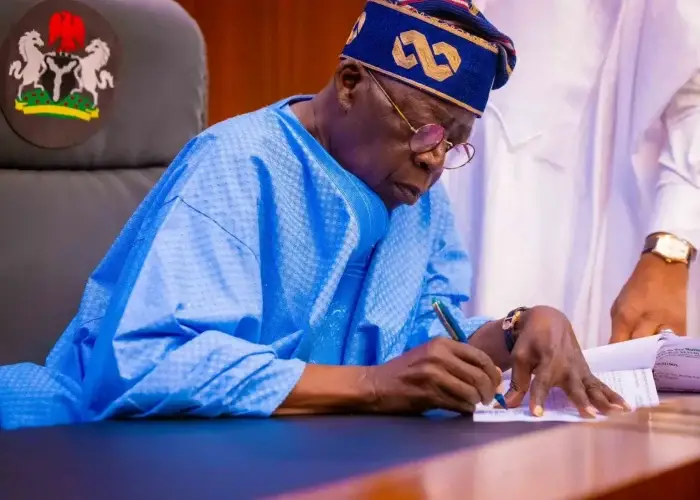

President Bola Tinubu has directed the Federal Ministry of Health and Social Welfare to ensure that members of the Nigerian Association of Resident Doctors (NARD) return to work immediately, following the total and indefinite strike they declared on Saturday.
The directive was disclosed on Monday in Abuja by the Minister of State for Health and Social Welfare, Dr. Iziaq Salako, during a press briefing.

“I would like to update Nigerians on the challenges around the ongoing strike action by the Nigerian Association of Resident Doctors. First, on behalf of myself and the Coordinating Minister of Health and Social Welfare, Prof. Muhammad Pate, and all the top management staff of the ministry, we would like to express our regrets and unconditional apology to Nigerians, especially those who needed to access health care in the last 48 hours, who could not do it as a result of the strike action by NARD,” Salako said.
He added, “I want to use this opportunity to assure Nigerians that Mr President has expressly directed that we do everything possible and legitimate to ensure that the resident doctors are brought back to their duty posts as soon as possible.”
READ ALSO:
- DSS Takes Custody Of El-Rufai After Court Proceedings, Ruling Fixed For April 14
- Sterling Bank Marks One Year Of Zero Transfer Fees, Returns N1.6bn To Customers
- Lagos CP Bans Taskforce From Traffic Enforcement Operations
- “Nothing I Do Is Ever Right” — Busola Oke Laments Constant Criticism
- Power Minister Adelabu Still In Office, Aide Dismisses Resignation Rumour
Salako explained that the government had been engaging NARD leadership to resolve the 19-point demands presented by the striking doctors, noting that each concern is being addressed. He also provided background on the dispute, citing a circular issued by the National Salaries, Incomes and Wages Commission (NSIWC) in July, which caused disagreements among health sector workers.
“We approached the National Salaries and Wages Commission and the Presidential Committee on Salary Increase, and the circular was therefore withdrawn,” Salako said, adding that a Collective Bargaining Agreement (CBA) process was initiated in August to unify discussions across all health sector unions, including the Nigerian Medical Association (NMA), National Association of Nigerian Nurses and Midwives (NANNM), and the Joint Health Sector Unions (JOHESU).
“Between August and now, we have had 12 meetings of the CBA. But in the course of that CBA meeting, two issues came out that were very controversial,” he explained.
Salako identified the first issue as a disagreement between groups advocating relativity in remuneration and those insisting on parity. “You cannot talk about parity in one breath as government, and also talk about relativity in another breath as government. They are mutually exclusive. And we felt that it was important to come back home to resolve that issue,” he said.
The second contentious matter involved the appointment of some non-doctor health workers as consultants in 2020, which caused discontent among doctors. “For us, we felt that it was an issue that we had to come and discuss in-house to resolve, and that is what led to a temporary suspension of the CBA,” Salako added.
He noted that an external consultant, a professor of industrial relations, was engaged to mediate on these two critical issues and any other matters arising during discussions with health unions. “That negotiator has met the three health unions, has submitted an interim report. We have met again with all the unions combined in the presence of the negotiator to further discuss, and the government is trying to put together a recommendation to the CBA on these two issues. That is why the CBA was temporarily halted. It was in the course of that suspension that NARD issued its ultimatum,” he said.
Addressing concerns about unregulated work hours and manpower shortages, Salako revealed that the government has approved massive recruitment in the health sector. “In 2024 alone, the Federal Ministry of Health, using a special waiver mechanism that no other sector enjoys, was able to engage 14,444 health workers across 64 federal tertiary health institutions. 78.1 per cent are clinical staff. Out of those clinical staff, 908 are consultants and 3,064 are resident doctors. In 2025, so far, using the same waiver mechanism, we have given approval, and recruitment is already ongoing across 78 federal tertiary health institutions for the employment of 23,059 health workers. 71.1 per cent are clinical staff. 868 are consultants and 2,629 are residents, also the second highest,” he said.
Salako added that President Tinubu had approved increasing the retirement age for clinical health workers to 65 years and emphasized that the policy is in its final stages of implementation.
On financial matters, he noted that substantial funds have been released to settle arrears and allowances. “The sum of N21.3bn has been released for the settlement of these arrears. At least 60 per cent of NARD members have received an alert. It is still remaining at about 40 per cent, and we are going to follow up with the Accountant-General and the Pay Office to ensure that the other 40 per cent are properly paid,” he said.
He added that N11.995bn had been processed for additional arrears, while N10bn had previously been paid to all health workers in August, with another N10bn paid exclusively to resident doctors through the Medical Residency Training Fund.
On concerns about poor hospital infrastructure, Salako urged journalists to visit facilities nationwide to verify ongoing improvements since May 2023. He stressed that President Tinubu remains committed to closing gaps in the health sector and ensuring sustainable agreements.
“There is no slow progress. What is happening is that we’re taking our time to ensure that everything we need to take on board is taken on board, so that whatever solution we agree on will be a sustainable one. The health sector is teamwork. No professional in the health sector can work independently of others. What happens to cadre A affects cadre B. We cannot treat their issues independently of one another,” he said.