




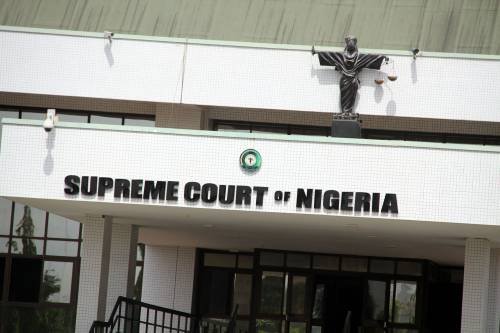

The Supreme Court on Monday upheld the President’s constitutional authority to declare a state of emergency in any state to prevent a breakdown of law and order, issuing a split six-to-one decision.
Delivering the lead judgment, Justice Mohammed Idris affirmed that Section 305 of the 1999 Constitution empowers the President to take extraordinary measures to restore normalcy during a state of emergency.

He explained that the provision does not define the exact nature of such measures, giving the President discretion in handling the situation.
“Section 305 of the 1999 Constitution empowers the President to adopt extraordinary measures to restore normalcy where a state of emergency has been declared,” Justice Idris said.
The judgment stemmed from a suit filed by the Attorneys-General of PDP-governed states, challenging the declaration of a state of emergency in Rivers State by President Bola Tinubu, during which elected state officials were suspended for six months. The Supreme Court had reserved judgment on the matter in October.
The plaintiffs, from Adamawa, Enugu, Osun, Oyo, Bauchi, Akwa Ibom, Plateau, Delta, Taraba, Zamfara, and Bayelsa states, sought clarity on whether the President has the constitutional authority to suspend elected state officials and replace them with unelected administrators during a state of emergency.
READ ALSO:
- First Niger Bridge Demarcation Not Demolished, FG Clarifies
- Donald Duke: I’ll Reduce Petrol Price To N300 If Elected President
- IBEDC Announces Power Outage In Ogun
- 20 Abducted Corps Members Regain Freedom
- NAF Crash: Pilot Averted Greater Disaster By Diverting Aircraft From Residential Area — Aiyedatiwa
Among other questions, the suit asked the court to determine “whether, upon a proper construction and interpretation of Sections 1(2), 5(2), 176, 180, 188, and 305 of the Constitution of the Federal Republic of Nigeria 1999, the President… can lawfully suspend… the offices of a Governor and the Deputy Governor… and replace them with his unelected nominee as a Sole Administrator, under the guise of, or pursuant to, a Proclamation of a State of Emergency in any of the Plaintiffs’ States.”
The Supreme Court upheld preliminary objections raised by the defendants—the Attorney-General of the Federation and the National Assembly—holding that the plaintiffs had failed to establish a cause of action to trigger the court’s original jurisdiction. Justice Idris struck out the suit for lack of jurisdiction but also addressed the substantive issues, ultimately dismissing the case on the merits.
However, Justice Obande Ogbuinya dissented, arguing that while the President can declare a state of emergency, that power does not extend to suspending elected state officials, including governors, deputy governors, and members of state legislatures.
The ruling cements the President’s authority to act decisively during crises but leaves unresolved debates over the limits of such powers regarding elected officials.