



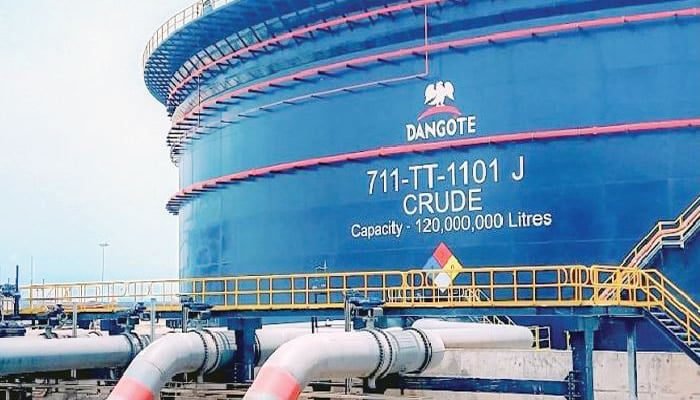

The Dangote Petroleum Refinery has started night-time loading operations as part of its push to maintain a daily supply of over 50 million litres of Premium Motor Spirit (petrol) across Nigeria, marking a significant move toward full 24-hour operations at Africa’s largest refinery.
The initiative is aimed at ramping up production, improving logistics, strengthening fuel security, and addressing concerns about potential supply disruptions and maintenance activities. Originally designed for daytime evacuation, the refinery has now extended loading operations into the night to match rising output with uninterrupted distribution.

Speaking at a press briefing on Wednesday, Managing Director David Bird explained that round-the-clock loading had become essential to meet market demand and improve product evacuation turnaround.
“What I’m incredibly proud of is that, in the second half of 2025, while we were still ramping up capacity of our conversion units and downstream units, we were still able to deliver 50 million litres a day, more frankly than 52 million litres on some occasions,” Bird said.
He added, “We’re already doing nighttime loading. So it’s a 24-hour operation. We have celebrated over 50 million litres of offtake as well, which means over a thousand trucks progressing through the gate and through the gantry. Really learning and continuously improving our logistics and our turnaround time of getting those trucks through.”
Bird stressed that sustaining high output is not only about production but also efficient distribution. “It’s volatile. We see a dip on weekends and so forth. It all depends on demand and available stocks; if not, we can export. But for me, the primary objective is to demonstrate that we can continue to produce over 50 million litres a day and then see where true market demand in Nigeria lies.”
He highlighted the link between stable fuel supply and economic activity: “Having a lower price and an abundance of supplies will stimulate demand, which is a good thing. That will continue to stimulate economic activity by having stable, affordable, clean fuels available. I do expect the demand to increase as a result of this stability and abundance of our product.”
READ ALSO:
- Plateau Killings: ‘No Amount Of Money Can Replace Them’ — Tinubu Comforts Jos Victim’s Mother
- “Nigeria Is Yet To See Tinubu’s Best” — Gbenga Daniel
- “I Brought Mercy Aigbe Into Nollywood, Now She Blocks Me” — Olaide Olabanji
- “I Don’t Know My Cancer Stage, I May Have Exaggerated” — Blessing CEO Opens Up (Video)
- Trump Claims Iran War Nearing End As Tensions Escalate
The MD also pointed to the refinery’s operational flexibility, noting that production can be maintained even during planned maintenance. “We have continued to deliver 50 million litres a day. We have built this flexibility into our system so that individual units can be taken out for maintenance and still meet finished product demand,” he said.
Describing Dangote as a highly flexible merchant refinery, Bird explained that petrol can be produced through multiple routes, including crude processing, intermediate feedstocks, and blending components.
“This is not just a single crude processing plant. It is a very flexible, resilient production process where we can make our finished product from crude, from intermediates through our conversion and treatment units, or by bringing in blending components,” he said.
Bird added that this flexibility allows the refinery to meet domestic demand consistently while maintaining export capability. “We have the requirement to be able to always export our finished product. By definition, that means we have to make world-quality fuels and ensure that we can land our product competitively anywhere in the world. We must make sure our production is compliant with Euro-5 gasoline and diesel.”
He also praised the refinery for transforming Nigeria’s fuel market. “Nigeria has gone from fuel scarcity to fuel abundance. Beyond volume, we are supplying cleaner, Euro V-compliant fuels, ending West Africa’s long-standing reputation as a dumping ground for substandard petroleum products,” Bird said.
Highlighting the importance of domestic refining for price stability, he added, “If you are fully import-dependent, you are exposed to global market fluctuations. Having domestic production drives a level of insulation from global volatility in both crude and product prices.”
Bird concluded that while exports remain an option, prioritising the domestic market is key to ensuring supply stability and supporting the nation’s economy.
“We are committed to maintaining 24-hour operations to meet domestic demand, ensure fuel security, and provide a stable supply to the Nigerian market,” he said.