



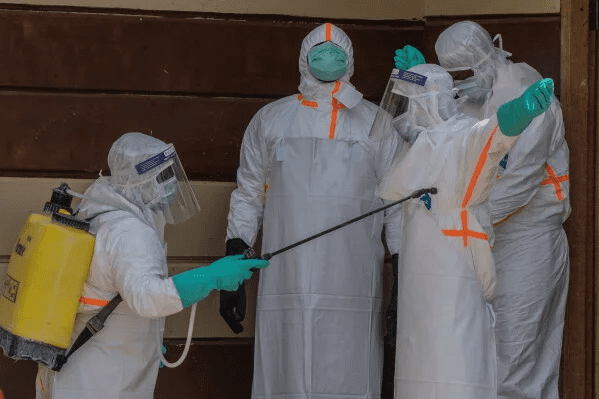

The Red Cross has warned that the deadly Ebola outbreak in the Democratic Republic of Congo has not yet reached its highest point and could take up to a year to contain.
Since authorities declared the outbreak on May 15, the World Health Organisation says 808 cases have been confirmed, with 192 deaths recorded so far.

Speaking from Bunia, the capital of Ituri province — the current epicentre in northeastern DRC — a senior International Federation of Red Cross and Red Crescent Societies (IFRC) official said the situation is still escalating.
Bruno Michon, IFRC operations manager for the Ebola response, told reporters in Geneva via video link that the outbreak is still growing. “Here in Bunia, what I can see is that we did not reach the peak of the epidemic,” he said.
Michon also raised concerns about limited testing capacity, saying it remains difficult to determine the true scale of the spread. “The peak is, I think, not beyond us, but in front of us,” he added, warning that the outbreak could last as long as a year.
There are currently no approved vaccines or treatments for the Bundibugyo strain responsible for the outbreak, which has mainly affected Ituri but has also been detected in North Kivu and South Kivu.
The virus has further spread beyond Congo’s borders, with neighbouring Uganda reporting 19 confirmed cases and two deaths.
READ ALSO:
- CAF Awards 2026 To Hold In Lagos
- Burna Boy, IGP Disu Explore Ways To Improve Police-Public Relations
- I Ended The Relationship After Discovering He Was Married – Actress Irewole Olaniyan Spills
- ECOWAS To Deploy Youth Observers For Nigeria’s 2027 Elections
- Madonna University Expels Nursing Student, Suspends 14 Over Viral TikTok Video
Michon stressed that controlling the outbreak will require not only medical intervention but also strong community engagement and trust-building.
He noted that Red Cross volunteers in the region have recently faced verbal abuse, threats, and physical attacks while carrying out response activities.
“Trust is not a secondary activity in an Ebola response,” he said. “Without trust, we cannot detect cases early, ensure safe burials, protect families, or stop transmission.”