



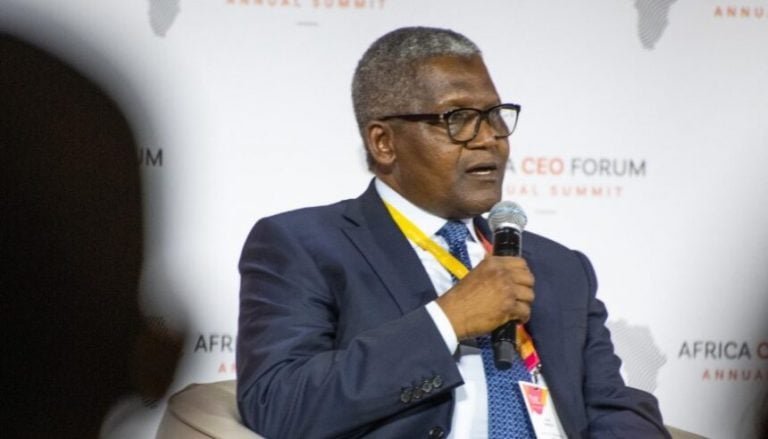

President of the Dangote Group, Aliko Dangote, has raised concerns that the ongoing crisis in the Middle East could push Nigeria and other African countries toward adopting work-from-home measures similar to those seen during the COVID-19 pandemic.
Dangote made this known on Monday after meeting with President Bola Tinubu at his residence in Ikoyi, Lagos. He warned that the situation could worsen economic conditions across the continent, especially due to fluctuating oil prices and limited financial reserves.

“If this thing doesn’t de-escalate, you know, normally we in Africa, we don’t have any reserves in terms of savings.
“And so, people normally go out and look for money for the next day or for even the same day. Some of them, if they don’t work that day, they won’t eat,” he said.
He pointed to how some countries are already responding to energy-related challenges, citing Indonesia as an example where workers have been directed to reduce working days, with the possibility of full remote work if conditions worsen.
“In some countries today what they’ve done, they asked everybody to work from home because they cannot afford it.
“I think Indonesians also only go to work four days a week. And they will look at the situation if it doesn’t improve, they will ask everybody not to go to work anymore.
“We will do like that time of COVID, where people will work from home,” Dangote stated.
The billionaire businessman stressed that Africa risks bearing the brunt of a crisis it did not create, warning that rising costs could further strain economies.
“It’s not only energy. Some people will try and take a chance and say, ‘Ah, this is an opportunity. So, let me make money.’
“So, if this thing doesn’t de-escalate, it is going to keep going up and up and up, and governments cannot really and add to salaries.
“So, people will really, really feel the pinch,” he said.
READ ALSO:
- How Badejo-Okusanya Began Her First Day As NBA President
- Abuja Hospital Suspends Kidney Transplant Services Over Organ-Harvesting Probe
- Super Eagles Get Dates For 2027 AFCON Qualifiers Against Madagascar, Guinea-Bissau
- Nollywood Actress Atinuke Kareem Dies After Battle With Breast Cancer
- Four Family Members Die As Three-Storey Building Collapses In Kwara
He added that the impact would be most severe on everyday Nigerians and small-scale business owners who rely heavily on fuel and generators for operations.
“People who are barbers, people who make bread, people who have industries, who have to pay for their own generators, you know, I mean, you can see what is happening,” he noted.
Dangote called for collective efforts to resolve the crisis, urging for prayers and swift global intervention.
“We just need all hands-on deck to pray that this thing comes to an end,” he said.
Commenting on President Tinubu’s recent trip to the United Kingdom, Dangote expressed optimism that it would boost investor confidence in Nigeria. He highlighted a £746 million infrastructure deal signed during the visit, describing it as a major signal of trust rather than just financial support.
“It has not been easy dealing with the British, getting this kind of money out of them. They too, they are struggling on their own. But I think this is to show confidence — it’s not about the money. It’s about the confidence in Nigeria,” he said.
He added that the agreement could encourage other nations to invest in Nigeria.
“The moment that they do that, there will be other countries that will follow suit. Germany will come, others will line up and start coming up,” Dangote stated.
He further disclosed that Nigerian investors can now access funding from UK Export Finance, a development he described as a major opportunity for private sector growth.
“For Nigerian investors, it has shown that we can also go to the same agency and tap the resources. It means that the agency now is open for business for Nigerians, and we will go as private people to look for them to give us support,” he explained.
The warning comes amid growing global concerns over oil price instability triggered by the Middle East crisis, with potential consequences for inflation, transportation, and energy-dependent sectors across Africa.