



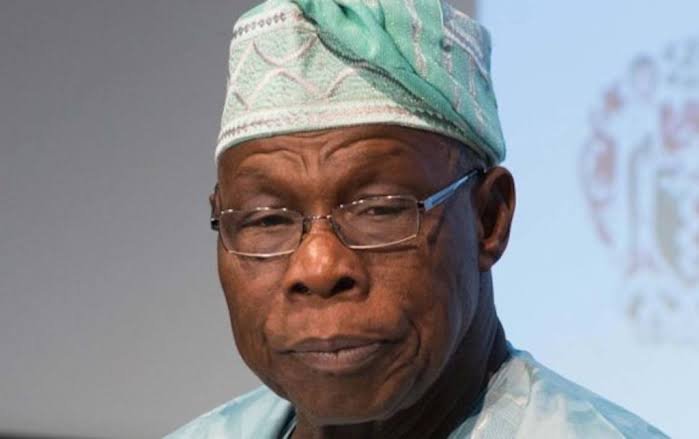

Former President Olusegun Obasanjo has urged Nigerian leaders to urgently address insecurity, unemployment and poverty, warning that poor governance is driving citizens to seek better living conditions abroad despite the dangers associated with irregular migration.
Obasanjo made the call on Saturday during a panel session titled “Lest We Forget” at the Creative Africa Nexus Weekend 2026, organised by the African Export-Import Bank in Lagos State.

Speaking on Nigeria’s security challenges since independence, the former president stressed the need for effective leadership and policies that would create employment opportunities, reduce poverty and tackle the growing incidence of kidnapping and other security threats.
“We just have to do what we should do to provide job opportunities, to stem the tide of impunity, to stem the tide of poverty, to stem the tide of kidnapping and insecurity,” he said.
Reflecting on his return to Nigeria in 1959 after completing his military training in Britain, Obasanjo recalled a period when he could travel freely across the country without fear of being attacked or kidnapped.
He said he was once posted to northern Nigeria and could move around the region alone, both during the day and at night, without security concerns.
“I came back to this country after my commission as an officer in Britain in 1959. And I could go anywhere; I was posted to the north; I could go anywhere in the north, by myself alone, by day, by night,” he said.
Comparing the situation with the present security challenges, Obasanjo questioned the factors responsible for the country’s decline and called on those in authority to address the underlying problems.
“Now, if you can’t do that, what has gone wrong? We have to correct what has gone wrong,” he stated.
The former president also identified unemployment among university graduates as a major challenge contributing to economic hardship and encouraging young people to seek opportunities outside Africa.
He argued that governments must ensure that educational institutions produce graduates who can find meaningful employment, rather than leaving them without opportunities to earn a living.
Obasanjo illustrated the consequences of unemployment by recounting an encounter with Nigerians arrested over drug-related offences. According to him, one of the suspects explained that he became involved in the illegal trade after losing his legitimate source of income.
He said the experience highlighted how economic difficulties could push people into desperate situations, although it did not excuse involvement in criminal activities.
READ ALSO:
- Obasanjo Blames Poor Leadership For Nigeria’s Insecurity, Poverty, Unemployment
- Nkechi Blessing’s Ex-Lover, Falegan, Seeks Forgiveness Over Messy Split
- NDLEA Arrests Ugandan Woman With 1.15kg Cocaine Hidden In Underwear At Lagos Airport
- ‘May Your Curses Return To You’ — Saidi Balogun Replies Critics Over Tinubu Campaign Rallies
- Flamingos Make History, Beat Japan To Win First-Ever FIFA U-17 Women’s World Cup Title
On irregular migration, Obasanjo spoke about Africans who had attempted to reach Europe through the Sahara Desert and the Mediterranean Sea, noting that many faced life-threatening conditions during the journeys.
“I have got those people who have attempted to cross, and the story they told me is pathetic. Some die in the Sahara, some die in the Mediterranean,” he said.
He maintained that improving governance and expanding economic opportunities across African countries would discourage citizens from embarking on dangerous journeys in search of a better life.
“We have to improve on our leadership to deliver, and once our leadership delivers, what does any man want in the world?” he asked.
“But if they have nothing here, they will look for whatever they can get anywhere else, and you can’t blame them.”
Addressing Africa’s development challenges, corruption and poor governance, Obasanjo blamed the continent’s political leaders for much of its failure to achieve its economic and social potential.
“Africa is not where it should be, and that Africa is not where it should be is substantially the responsibility of our leaders. It’s as simple as that,” he declared.
Beyond Nigeria’s domestic challenges, the former president advocated the removal of visa restrictions among African countries to encourage easier movement across the continent.
He disclosed that he had discussed a proposal with Ghanaian President John Mahama to eliminate visa requirements among about 25 African countries, particularly those already operating visa-on-arrival arrangements.
According to Obasanjo, the initiative could serve as an initial step towards achieving unrestricted movement across the continent if successfully implemented.
“These countries should eliminate visas among themselves, about 25 of them, and if they are able to do it successfully, then maybe in a matter of a few years, the whole of Africa will be able to move,” he said.
He also expressed concern over the limited acceptance of the African passport and called on governments across the continent to make it easier for people of African descent in the diaspora to acquire citizenship.
“I believe that all African states should have such a policy. That anybody from the diaspora who wants to be a national of any African country should automatically be given,” he said.
Obasanjo further stressed the importance of unity among Africans on the continent and those living abroad, noting that historical divisions should not prevent collective efforts towards development and prosperity.
The panel session also featured former Prime Minister of St Vincent and the Grenadines, Dr Ralph Gonsalves, and Jamaican scholar, Prof. Paulette Ramsay. Discussions centred on African identity, slavery, colonialism, reparations and the need to strengthen relationships between Africa and its diaspora.
The speakers called for reparatory justice over the trans-Atlantic slave trade and colonialism, arguing that the historical exploitation of Africans continues to have consequences for the continent.
Ramsay, author of Lest We Forget: Slavery, Slave Trade, Colonisation, Emancipation and Reparation, praised Obasanjo for supporting the publication, which brings together scholars, policymakers and cultural experts to examine Africa’s historical experiences.
She maintained that reparations should go beyond financial compensation to include the return of stolen African artefacts, improved protection of cultural heritage and an end to the exploitation of the continent’s natural resources.
“We must not remember with bitterness. We must teach younger generations that we remember the horrible things that were done, but we survived, and that’s the best part of the African story, that we survived,” she said.