



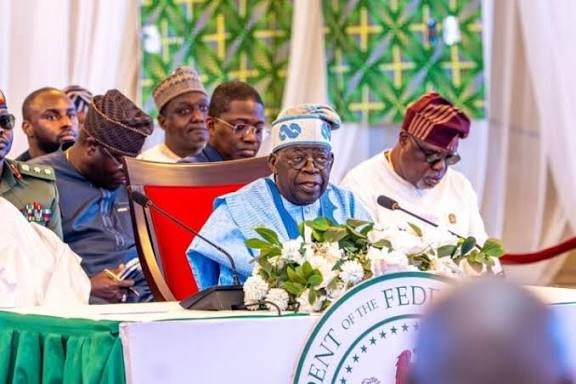

President Bola Tinubu has pledged decisive measures to tackle insecurity in Nigeria, emphasizing that threats like terrorism and banditry undermine both national security and economic progress.
Speaking on Monday at the second edition of the National Economic Council (NEC) conference, the president noted the urgency of strengthening security forces to protect Nigerians and support economic growth.

“I believe we are here again to further find means to strengthen our security forces, to defeat terrorism and combat banditry,” Tinubu said. “That, I promise you, is what affects all of us; sleepless nights. But I assure you that we will win with determination and resilience.”
Describing terrorism and banditry as alien to Nigeria’s culture, the president insisted they must be eradicated. “We will overcome this unacceptable terrorism and banditry; it is not part of our culture,” he said, adding that failing to address insecurity promptly would continue to hinder economic development. “It’s an economic hindrance if we do not find immediate solution to it.”
Tinubu praised governors of states like Borno and Kaduna for their efforts in tackling insecurity and assured that the federal government would continue collaborating with states to restore peace while protecting lives and property.
He also linked security to broader development goals, highlighting that strengthening security is central to achieving inclusive growth under the Renewed Hope National Development Plan.
The president commended NEC, chaired by Vice President Kashim Shettima, for providing a platform for policy coordination and strategic dialogue. He also highlighted his administration’s economic reforms, noting their positive impact on stabilizing the economy and restoring investor confidence.
“I must say again at this juncture, the monetary policy that we have embarked on since the reforms has yielded positive results and gained recognition around the world,” he said, praising Central Bank of Nigeria Governor Yemi Cardoso for restoring confidence in the country’s monetary policy framework.
Tinubu noted that increased and more predictable federal allocations to state and local governments have strengthened their capacity to pay salaries, invest in infrastructure, and deliver social services. He also emphasised the administration’s commitment to infrastructure development across sectors including transportation, power, digital connectivity, housing, and irrigation.
The president highlighted social investment and human capital programmes targeting vulnerable groups, youth, women, and small businesses, stressing the importance of grassroots-focused initiatives under the Renewed Hope agenda.
READ ALSO:
- Atiku Demands Accountability For Subsidy Savings As ASUU Threatens Strike
- INEC Releases Final List Of 1,195 Candidates For 2027 Senate Elections
- Troops Rescue Three Kidnap Victims After Terrorist Attack In Zamfara
- DSS Warns Osun Religious Leaders Of Planned Terrorist Attacks Ahead Of 2027 Election
- NDLEA Intercepts 44kg Colorado In UK Shipments, Arrests Seven In Lagos
“The Renewed Hope Ward Development Project further demonstrates our commitment to grassroots inclusion through a bottom-up approach to national development,” he said. “These successes reflect strong collaboration among the federal and state governments, development partners and the private sector.”
Looking ahead, Tinubu said the Renewed Hope National Development Plan 2026–2030 represents the next phase of Nigeria’s development journey, anchored on inclusive, resilient, and environmentally sustainable growth.
“The plan prioritises economic diversification and productivity; human capital development; subnational competitiveness based on comparative advantage; private sector-led growth; and climate resilience,” he said. “Its success will depend largely on effective implementation at the state and local government levels, making NEC central to aligning national priorities with subnational realities.”
He concluded by urging actionable solutions and measurable results, emphasizing innovation, data-driven decision-making, and peer learning among states. Tinubu expressed optimism that resolutions from the conference would advance initiatives such as agricultural diversification, dairy farming, livestock investment, and ranching.