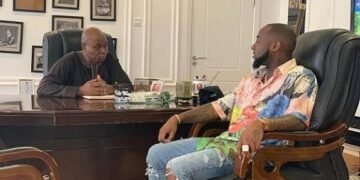





Dr Deji Adeleke, billionaire entrepreneur and philanthropist, has given an extensive account of the long-running paternity controversy involving his son, Afrobeats star Davido, firmly dismissing claims that the singer fathered a girl named Anuoluwapo.
Addressing journalists on Wednesday, Adeleke described the allegation as unfounded, alleging that controversial social media figure Kemi Olunloyo has repeatedly fueled the narrative over the years by impersonating the child and her mother online.

The claim, which dates back more than a decade, originated from Ibadan-based woman Ayo Labinjo, who alleged she became pregnant after an encounter with Davido during one of his visits to the city. She claimed the relationship resulted in the birth of a daughter, Anu, whom the singer allegedly refused to acknowledge.
The issue resurfaced recently when an Instagram account believed to be linked to the child publicly appealed to Davido to undergo another DNA test. Davido responded by insisting that five separate DNA tests had already been conducted, all of which excluded him as the child’s biological father.
Explaining why he decided to speak publicly after years of silence, Adeleke said the persistent circulation of the story left him with little choice.
“I am Deji Adeleke, I’m the father of five children, three boys and two girls. David Adeleke, who you all know as Davido, is the baby of my family, he’s the last,” he said.
He added, “I’m calling this press conference, and this is my very first time addressing the press, and for just one single reason. I’m not on social media, but I’m sure those of you on social media have been inundated with all kinds of talks about this issue that keeps coming up almost every year, regarding one little girl called Anuoluwapo, who lives in Ibadan, whom Kemi Olunloyo has continually alleged that David is the father of the little girl.”
Adeleke traced the controversy to 2014, when he said he received a courier package from Ibadan containing photographs, documents, and a birth certificate bearing Davido’s name as the child’s father, alongside a letter from the child’s grandmother.
READ ALSO:
- Invest in Nigeria’s Future: Subscribe to the Dangote Refinery IPO Through FirstBank
- Dangote Price Hike Pushes Petrol To N1,395 Per Litre In Lagos
- Labour Party Chieftain Sues UNN Over Peter Obi’s Academic Records
- INEC Releases Final List Of 2027 Presidential Candidates
- Ondo Alcohol Poisoning Death Toll Rises To 30 As 60 Cases Recorded
“Tracing the matter back to its origin, Adeleke explained that he first became aware of the claim in 2014, when he received a DHL package from Ibadan containing photographs of Davido and the child, a birth certificate listing ‘Adeleke David’ as the father, and a letter from the child’s grandmother.”
According to Adeleke, the grandmother, a widow, stressed that her family was not seeking marriage or financial benefit but simply wanted clarity through a paternity test.
“Also in the package was a letter from the grandmother of Anu, including her phone number. She wrote that she was a widow with two daughters, that she lost her husband years ago and raised them alone,” he said.
“She said her eldest daughter informed her that David Adeleke was responsible for her pregnancy after meeting him when he came to Ibadan for a show. She said her daughter gave birth to a baby girl and asked that David step up for a paternity test. She stated clearly that she was not asking David to marry her daughter, only to confirm paternity and take responsibility if confirmed.”
Adeleke said he immediately reached out to the family and assured them that he would gladly accept the child into his family if the DNA test proved she was his granddaughter. He explained that he personally arranged the first test at a Lekki-based hospital, with samples sent abroad for analysis.
“Immediately I read the letter, even before speaking to David, I called the woman. I told her I hadn’t spoken to my son yet, but if the child was truly my granddaughter, she had no problem with me. I would welcome her into my family happily,” he said.
He added, “I sent my driver to Ibadan to confirm where they lived. I told her about the hospital I use in Lekki, an Indian hospital, where DNA tests could be arranged. The hospital explained that samples would be taken in Nigeria but sent to South Africa for analysis.”
He explained that saliva samples were collected from Davido and the child in the presence of both families, with the results shared with him and the child’s grandmother.
“On the appointed day, my driver brought the mother, the grandmother, and the child to Lagos. David, myself, and his aide met them at the hospital. Only David, myself, the grandmother, the mother, and the child were allowed into the room. Samples were taken using saliva, not blood, and sealed for analysis.”
The test results, Adeleke said, showed a zero per cent probability of paternity.
“When the results were ready, both the grandmother and I went to collect them together, as agreed. The result stated that the probability of paternity was zero percent. The lab explained clearly that David was not the father of the child.”
Despite the outcome, Adeleke said he recommended additional DNA tests to completely remove doubt, offering to cover accommodation and logistics for the family while the tests were conducted.
“The grandmother broke down and cried. I told her mistakes could happen and suggested we do two more DNA tests at other reputable centers. I offered to keep them in Lagos for a week at my expense so additional tests could be carried out.”
He said subsequent tests also ruled Davido out as the child’s biological father.
Adeleke rejected calls to release the DNA reports publicly, warning of security and privacy risks.
“It is dangerous for anyone’s DNA profile to be in the public domain,” he said.
He stressed that the family had no reason to deny a child, noting that he already has 14 grandchildren.
“What is one more?” Adeleke asked. “Is it that I cannot afford to take care of her? But there is science. And science is clear.”
He concluded by urging the public to be cautious of narratives circulating online, insisting the renewed debate is driven by impersonation and misinformation rather than facts.